- Polyphia
- Playing God, arr. ArcoStrum (2022)
- ArcoStrum
- Opening (2024)
- Astor Piazzolla
(1921-1992) - Primavera Porteña (Buenos Aires Spring) arr. ArcoStrum (1969)
- Zhihui Li
(b. 1972) - Ink Orchid Pavilion 水墨兰亭, arr. ArcoStrum (2011)
- Haihuai Huang
(1935-1967) - Horse Racing 赛⻢, arr. ArcoStrum (1959)
- Domenico Scarlatti
(1685-1757) - Keyboard Sonata, K. 141, arr. ArcoStrum (1739)
- John Williams
(b. 1932) - Theme from Schindler’s List, arr. ArcoStrum (1993)
- Antonio Vivaldi
(1678-1741) - Summer from The Four Seasons, arr. ArcoStrum (1723) Presto
- Astor Piazzolla
(1921-1992) - Nightclub 1960 from The History of Tango, arr. ArcoStrum (1969)
- Antonio Vivaldi
(1678-1748) - Winter from The Four Seasons, arr. David Galvez (1723) Allegro non molto
- Katona Twins
- Michael Jackson meets Scarlatti, arr. ArcoStrum (2024)
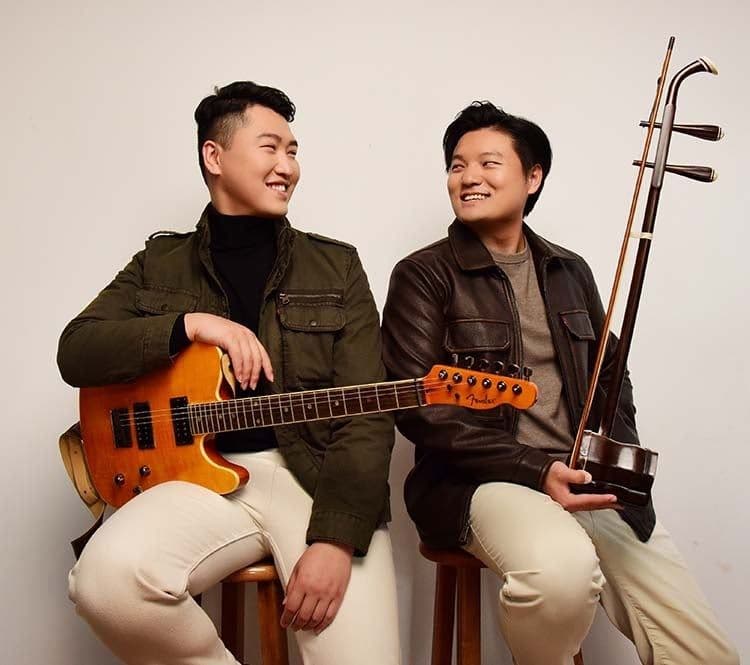
ArcoStrum
Apr 22 | Jackson Lounge
Program
ArcoStrum
Club 750 Music
- Strauss Shi
Violin, Erhu,
and Dizi - TY Zhang
Classical Guitar
and Electric Guitar
Run time is approximately 60 minutes, with no intermission.
Embark on a truly groundbreaking musical journey with The ArcoStrum Experience: a multi-instrumental, genre-defying showcase that seamlessly intertwines the contemporary Tango mastery of Piazzolla and the timeless classics of Vivaldi's Four Seasons. This innovative performance fuses the rich tapestry of Chinese traditional folk music, featuring the mesmerizing sounds of the dizi and erhu, with classical and electric guitar. Enter the realm of American instrumental rock by Polyphia, creating a harmonious blend of diverse musical landscapes. Immerse yourself in this extraordinary fusion, where high-impact visuals, humor, compelling stories, and dazzling virtuosity come together to captivate you from the opening note to the finale. The ArcoStrum Experience promises a one-of-a-kind concert, transcending boundaries and celebrating the evolution of music across genres and eras.
Instruments: Violin, Classical Guitar, Electric Guitar, Erhu (Chinese two-string fiddle), Flute Dizi (Chinese bamboo flute), Piccolo Dizi (Chinese bamboo flute)
This acclaimed instrumental ensemble took its name from the Italian word for playing with the bow, “arco,” and the word for strumming a guitar. The instrumentalists perform both original and arranged music in a variety of styles. Each ArcoStrum performer plays at least two instruments that represent different times, places, and styles of music. This introductory note is focused on the instruments themselves and on the art of arranging.
The violin is the product of developments across several centuries of bowed stringed instruments. It achieved its basic form in the highly acclaimed workshop of Andrea Amati (1505-1577), with further improvements made by his family members. Among grandson Nicolò Amati’s pupils (1596-1684) were the outstanding 17th Century luthiers Antonio Stradivari (1644-1737) and Giuseppe Guarnieri (1698-1744). Modern luthiers (the term used for all stringed-instrument makers) have continued to use techniques very similar to those developed by their predecessors, including the shape of the instrument and the use of exotic woods, four gut (or steel) strings, and a fingerboard without frets. The bow developed in parallel with the instrument. It consists of several parts, the most visible of which are the “stick” and the “hair.” For centuries, the bow’s stick has been made of rare woods, especially pernambuco from Brazil. Horsehair is most commonly used for the part that touches the strings. The musician presses the taut hair against the strings, producing a remarkably strong sound as the body of the instrument resonates with the strings. Although other techniques, such as plucking the strings, may be required by the music, the bow is the most frequently used method of producing sound. Italy was the home of the most important developments related to the violin family of instruments.
The modern classical guitar is also largely the product of generations of musicians who made and played the instrument and its antecedents. In the late 1700s, the instrument was primarily made with five strings. Around 1800, the use of six strings became more common. This allowed the instrumentalist to play a bass line as well as the usual treble. Therefore, the classical-style guitar could play more delicate figures, both in accompaniments and as a solo instrument, in contrast to the more folk-oriented guitars that were primarily strummed. The fretted soundboard was also subject to further refinements. The printed music of the 19th Century began to adopt modern notation rather than the tablature that was used with lutes and other earlier instruments. Although guitar prototypes were played throughout the world, Spain was the most fertile source of developments.
Traditional Chinese instruments are featured in some compositions in this concert. The dizi, often called a Chinese or bamboo flute, has been traced to the 5th Century BC. The flute dizi corresponds closely to the modern orchestral flute, with a range of about 2 l/2 octaves. The piccolo dizi corresponds to the modern piccolo. At least five other ranges of the instrument exist. The dizi is usually made of bamboo, with a membrane at the mouth that produces a characteristic buzzing sound. There are no keys, such as would be found in a modern flute. The player holds the instrument across the body and the pitches are sounded by precise placement of the fingers on the tone holes. Traditionally, the instrument was used in folk ensembles, Chinese ooper, and other specifically Chinese styles, but increasingly it is being used as a solo instrument in both ensembles and full symphony orchestras.
The second Chinese traditional instrument is the erhu, or two-string fiddle. It dates to the Tang Dynasty, roughly 618-907 BC. Like the dizi, it was heavily used in folk ensembles, Chinese opera, and other traditional styles, but it has increasingly become a part of modern popular music and incorporated into orchestral music. The instrument is made from hardwood, with two strings attached at the top and bottom. There is no fingerboard; the strings are quite loose and are pulled toward the neck with the left hand. At the base of the instrument is a wood box or resonator, the front of which is covered with python skin. The bow, which is usually made of bamboo and horsehair, is placed between the strings and cannot be removed without unstringing the instrument. The hairs of the bow produce the pitch, which is amplified by the skin. Although the pitch range can approach three octaves, the most resonant and useful sound covers two and a half octaves.
The first electric guitar was released to the public in 1932 as a jazz instrument. Many shapes and materials have been used over the years to produce specific effects. The guitar body is usually solid and may be made of wood, plastic, metal, or other materials. Unlike the classical guitar, the instrument’s body does not produce significant amplification. Instead, the strings’ vibrations are picked up individually by electric amplifiers, which transmit the sound to a speaker. Without these microphone pick-ups, the strings are nearly inaudible. However, with this electric connection, the instrument can be heard with any ensemble. The electric guitar is employed worldwide for all styles of popular music.
The violin and guitar are considered complementary instruments, and many composers, especially in Italy, France, Spain, and Portugal, wrote prolifically for this combination in the Baroque and Classical eras. It was also common for composers to freely borrow and rearrange the music of their peers. For example, Johann Sebastian Bach reworked some of Antonio Vivaldi’s violin concertos into organ concertos. Wolfgang Mozart reorchestrated George Handel’s “Messiah” score to enlarge the orchestra to Classical-era standards. ArcoStrum follows in that tradition by using arrangements of many different styles and compositions, from Vivaldi and Piazzolla to contemporary popular music. Today’s arrangers must contend with layers of copyright and permissions, which was not a factor in earlier times. The reworking of the original pieces, as well as new compositions, has resulted in a unique sound for ArcoStrum, which audiences have thoroughly enjoyed.
—Notes by Mary Black Junttonen, Retired MSU Music Librarian
Solo Acts
$6 each or bundle of 4 for $20
“Houghton Handheld”
Cudighi – Mozz + Tomato – Peppers + Onions – Open-Face
“Fret Croquette”
Potato – Plant-Based Cheeseburger – Tomato + Pickle + Onion – Ketchup – Mustard – Sesame (VG)
“Fingerboard Fry”
Twice-Fried Popcorn Turkey – Sweet Corn + Pimento Pancake – Herb + Apple Pesto
“Electric Spice”
Gochujang Krispies – Mushroom Bulgogi – Honey + Toasted Sesame – Scallion (GF/VG)
Ensembles
$12 each or bundle of 2 for $20
“Duo Delights”
Chorizo (GF) and Manchego (GF/V) – Soppressata (GF) and Brie (GF/V) – Toscano Salami (GF) and Pecorino Tartufo (GF/V) – Olives (GF/VG) and Pickles (GF/VG) – Fruits (GF/VG) and Nuts (GF/VG) – Bread (VG) and Crackers (GF/VG)
“String Pop Short Plate”
Wild Rice and Arborio – Caramelized Onion + Rutabaga – Pumpernickel Crusted Whitefish – Maple Carrot Puree – Roasted Red Pepper Coulis
Sweet Chops
$8 each
“Bridge and Saddle Bake”
Deep Dish – Cream Cheese Danish Sauce – Tart Cherries – Vanilla Streusel – Vanilla Bean Ice Cream (V)
“Soundhole Sorbet”
Dragon Fruit – Tropical Blend – Boba – Passion Fruit Coulis – Chocolate Toffee (GF/VG)