Royal Philharmonic Orchestra with Ray Chen

Royal Philharmonic Orchestra with Ray Chen

Jan 26 | Cobb Great Hall

Program

Royal Philharmonic Orchestra with Ray Chen

Vasily Petrenko,
Conductor and Music Director

Ray Chen,
Violin

  • Carl Nielsen
    (1865-1931)
  • Helios Overture, Op. 17
  • Pyotr Ilyich Tchaikovsky
    (1840-1893)
  • Violin Concerto in D Major, Op. 35
    Allegro Moderato
    Canzonetta: Andante
    Finale: Allegro vivacissimo

INTERMISSION

  • Jean Sibelius
    (1865-1957)
  • Symphony No.2 In D Major, Op. 43
    Allegretto
    Tempo Andante, ma rubato
    Vivacissimo
    Finale: Allegro moderato

The performance will run approximately 110 minutes, with one intermission.

First Violins

  • Duncan Riddell
  • Tamás András
  • Janice Graham
  • Esther Kim
  • Lauren Bennett
  • Savva Zverev
  • Andrew Klee
  • Kay Chappell
  • Anthony Protheroe
  • Erik Chapman
  • Adriana Iacovache-Pana
  • Imogen East
  • Momoko Arima
  • Judith Choi-Castro
  • Joanne Chen
  • Izzy Howard

Second Violins

  • Andrew Storey
  • Alexandra Lomeiko
  • Jennifer Christie
  • Charlotte Ansbergs
  • Jennifer András
  • Peter Graham
  • Stephen Payne
  • Manuel Porta
  • Inês Soares Delgado
  • Sali-Wyn Ryan
  • Charles Nolan
  • Leonardo Jaffe
  • Susie Watson
  • Clare Wheeler

Violas

  • Abigail Fenna
  • Wenhan Jiang
  • Liz Varlow
  • Joseph Fisher
  • Ugne Tiškuté
  • Esther Harling
  • Jonathan Hallett
  • Pamela Ferriman
  • Gemma Dunne
  • Raquel Lopez Bolivar
  • Kate Correia De Campos
  • Annie-May Page

Cellos

  • Rosie Biss
  • Jonathan Ayling
  • Chantal Woodhouse
  • Roberto Sorrentino
  • Jean-Baptiste Toselli
  • Rachel van der Tang
  • Naomi Watts
  • Anna Stuart
  • Emma Black
  • George Hoult

Double Basses

  • Jason Henery
  • Alice Durrant
  • David Gordon
  • Ben Wolstenholme
  • Joe Cowie
  • Martin Lüdenbach
  • Lewis Reid
  • Guillermo Arevalos

Flutes

  • Amy Yule
  • Joanna Marsh
  • Diomedes Demetriades

Piccolo

  • Diomedes Demetriades

Oboes

  • Tom Blomfield
  • Hannah Condliffe

Clarinets

  • Sonia Sielaff
  • Katy Ayling

Bassoons

  • Richard Ion
  • Ruby Collins

Horns

  • Alexander Edmundson
  • Ben Hulme
  • Finlay Bain
  • Zoë Tweed
  • Paul Cott

Trumpets

  • Matthew Williams
  • Kaitlin Wild
  • Mike Allen

Trombones

  • Roger Cutts
  • Ryan Hume

Bass Trombone

  • Josh Cirtina

Tuba

  • Kevin Morgan

Timpani

  • James Bower

MANAGEMENT TEAM

  • Managing Director
  • Sarah Bardwell
  • Business Development Director/ Deputy Managing Director
  • Huw Davies
  • Finance Director
  • Ann Firth
  • Director of Artistic Planning and Partnerships
  • Tom Philpott
  • Concerts Director
  • Frances Axford Evans
  • Tours Manager
  • Rose Hooks
  • Tours Coordinator
  • Victoria Webber
  • Director of Community and Education
  • Chris Stones
  • Senior Orchestra Manager
  • Kathy Balmain
  • Orchestra Manager
  • Rebecca Rimmington
  • Librarian
  • Patrick Williams
  • Stage Managers
  • Dan Johnson
    Toni Abell
    Sam Swift

Artist Biographies

Vasily Petrenko

Vasily Petrenko is Music Director of the Royal Philharmonic Orchestra, a position he assumed in 2021, and which ignited a partnership that has been praised by audiences and critics worldwide. The same year, he became Conductor Laureate of the Royal Liverpool Philharmonic Orchestra, following his hugely acclaimed 15-year tenure as their Chief Conductor from 2006 to 2021. He is the Associate Conductor of the Orquesta Sinfónica de Castilla y León and has also served as Chief Conductor of the European Union Youth Orchestra (2015-2024), Chief Conductor of the Oslo Philharmonic Orchestra (2013-2020) and Principal Conductor of the National Youth Orchestra of Great Britain (2009-2013). He stood down as Artistic Director of the State Academic Symphony Orchestra of Russia 'Evgeny Svetlanov' in 2022, having been their Principal Guest Conductor from 2016 and Artistic Director from 2020.

He has worked with many of the world's most prestigious orchestras, including the Berlin Philharmonic, Bavarian Radio Symphony, Leipzig Gewandhaus, London Symphony, London Philharmonic, Philharmonia, Accademia Nazionale di Santa Cecilia (Rome), St Petersburg Philharmonic, Orchestre National de France, Czech Philharmonic and NHK Symphony orchestras, and in North America has led the Philadelphia Orchestra, Los Angeles Philharmonic Orchestra, Cleveland Orchestra, and the San Francisco, Boston and Chicago Symphony orchestras. He has appeared at the Edinburgh Festival, Grafenegg Festival, and BBC Proms. Equally at home in the opera house, and with over 30 operas in his repertoire, Vasily has conducted widely on the operatic stage, including at Glyndebourne Festival Opera, the Opéra National de Paris, Opernhaus Zürich, Bayerische Staatsoper, and the Metropolitan Opera, New York.

Recent highlights as Music Director of the Royal Philharmonic Orchestra have included wide-ranging touring across major European capitals and festivals, China, Japan and the USA. In London, recent acclaimed performances have included Mahler's choral symphonies and concerts with Yunchan Lim and Maxim Vengerov at the Royal Albert Hall, performances at the BBC Proms, and the Icons Rediscovered and Lights in the Dark series. In the 2025--26 Season, at the Royal Albert Hall, they will perform three mighty Mahler symphonies alongside Bernstein's Chichester Psalms and Korngold's Violin Concerto. At the Royal Festival Hall, highlights include Shostakovich's Symphony No. 10, Messiaen's Turangalîla-Symphonie, orchestral music from Wagner's Parsifal and Scriabin's Symphony No. 3, 'The Divine Poem.'

Vasily has established a strongly defined profile as a recording artist. Amongst a wide discography, his Shostakovich, Rachmaninov, and Elgar symphony cycles with the Royal Liverpool Philharmonic Orchestra have garnered worldwide acclaim. With the Oslo Philharmonic Orchestra, he has released cycles of Scriabin's symphonies and Strauss' tone poems, and an ongoing series of the symphonies of Prokofiev and Myaskovsky. In autumn 2025, he launches a new partnership between the Royal Philharmonic Orchestra and the Harmonia Mundi label, with Elgar's Falstaff and Rachmaninov's The Bells, to be followed by subsequent releases of Strauss, Bartók and Stravinsky.

Born in 1976, Vasily was educated at the St. Petersburg Capella Boys Music School and St. Petersburg Conservatoire. He was Gramophone Artist of the Year (2017), Classical BRIT Male Artist of the Year (2010), and holds honorary degrees from Liverpool's three universities. In 2024, Vasily also launched a new academy for young conductors, co-organized by the Primavera Foundation Armenia and the Armenian National Philharmonic Orchestra.

Vasilypetrenkomusic.com

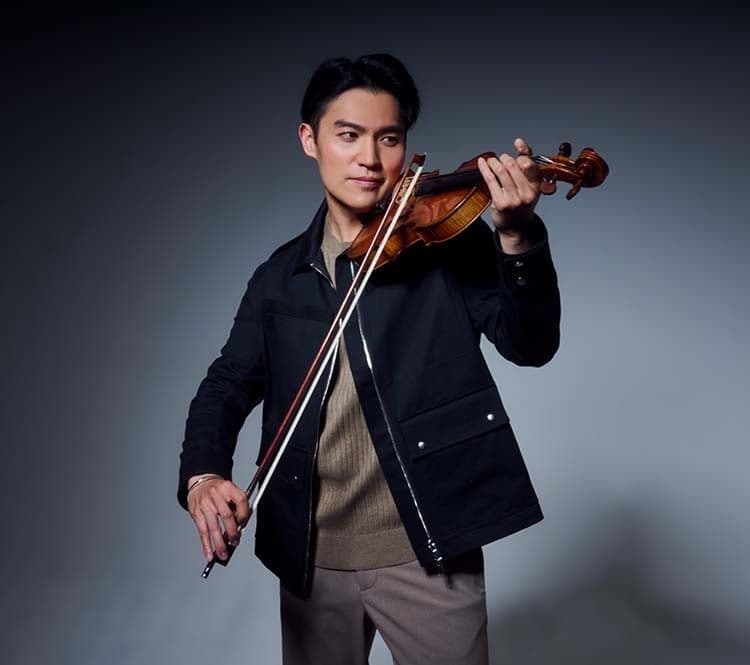
Ray Chen

Violinist and online personality Ray Chen redefines what it means to be a classical musician in the 21st century. With a global reach that enhances and inspires a new classical audience, Ray Chen's remarkable musicianship transmits to millions around the world, reflected through his engagements both online and with the foremost orchestras and concert halls around the world. Beyond the performing arts, his work has also contributed to philanthropy, popular culture and educational technology.

Initially coming to attention via the Yehudi Menuhin (2008) and Queen Elizabeth (2009) Competitions, of which he was First Prize winner, he has built a profile in Europe, Asia, and the USA as well as his native Australia both live and on disc. Signed in 2017 to Decca Classics, the summer of 2017 has seen the recording of the first album of this partnership with the London Philharmonic as a succession to his previous three critically acclaimed albums on SONY, the first of which ("Virtuoso") received an ECHO Klassik Award. Profiled as "one to watch" by  Strad and Gramophone magazines, his profile has grown to encompass his featuring in the Forbes list of 30 most influential Asians under 30, appearing in major TV series, Mozart in the Jungle, a multi-year partnership with Giorgio Armani (who designed the cover of his Mozart album with Christoph Eschenbach) and performing at major media events such as France's Bastille Day (live to 800,000 people), the Nobel Prize Concert in Stockholm (telecast across Europe), and the BBC Proms.

He has appeared with the London Philharmonic Orchestra, National Symphony Orchestra, Leipzig Gewandhausorchester, Munich Philharmonic, Filarmonica della Scala, Orchestra Nazionale della Santa Cecilia, Los Angeles Philharmonic, SWR Symphony, New York Philharmonic, San Francisco Symphony, Pittsburgh Symphony, Berlin Radio Symphony, and Bavarian Radio Chamber Orchestra. He works with conductors such as Riccardo Chailly, Vladimir Jurowski, Sakari Oramo, Manfred Honeck, Daniele Gatti, Kirill Petrenko, Krystof Urbanski, and Juraj Valcuha.

More recently, Ray Chen co-founded Tonic, an independent startup that aims to motivate musicians and learners around the world to practice their craft together. Although new, the innovative app has cultivated a highly engaged and supportive community and is available to download on iOS and Android today. Ray Chen's presence on social media makes him a pioneer in an artist's interaction with their audience, utilizing the new opportunities of modern technology. His appearances and

interactions with music and musicians are instantly disseminated to a new public in a contemporary and relatable way. He is an ambassador for SONY Electronics, a music consultant for Riot Games—the leading esports company best known for League of Legends and has been featured in Vogue magazine. He released his own design of a violin case for the industry manufacturer GEWA and proudly plays Thomastik Infeld strings. His commitment to music education is paramount and inspires the younger generation of music students with his series of self-produced videos combining comedy, education, and music. Through his online promotions his appearances regularly sell out and draw an entirely new demographic to the concert hall. "It's hard to say something new with these celebrated works; however, Ray Chen performs them with the kind of authority that puts him in the same category as Maxim Vengerov."

Born in Taiwan and raised in Australia, Ray was accepted to the Curtis Institute of Music at age 15, where he studied with Aaron Rosand and was supported by Young Concert Artists. He plays the 1714 "Dolphin" Stradivarius violin on loan from the Nippon Music Foundation. This instrument was once owned by the famed violinist, Jascha Heifetz.

Royal Philharmonic Orchestra

The Royal Philharmonic Orchestra (RPO), with Music Director Vasily Petrenko, is on a mission to bring the thrill of live orchestral music to the widest possible audience. The RPO's musicians believe that music can—and should—be a part of everyone's life, and they aim to deliver on that belief through every note. Based in London and performing around 200 concerts per year worldwide, the RPO brings the same energy, commitment, and excellence to everything it plays, be that the great symphonic repertoire, collaborations with pop stars, or TV, video game, and movie soundtracks. Proud of its rich heritage yet always evolving, the RPO is regarded as the world's most versatile symphony orchestra, reaching a live and online audience of more than 70 million people each year.

Innovation is in the RPO's genes. Sir Thomas Beecham, who founded the RPO in 1946, was a force of musical nature: an entrepreneur, a wit, and a conductor of great integrity, and he believed that great music-making belonged to everyone and that Britain needed an orchestra that was as adaptable as it was brilliant. This vision has remained integral to the RPO's approach. The RPO was one of the first orchestras to set up a community and education program, RPO Resound, and the first orchestra to create its own record label, as well as the first to travel to America post-COVID-19.

Throughout its history, the RPO has performed with the world's most inspiring musicians, including André Previn, Yehudi Menuhin, Yuri Temirkanov and Vladimir Ashkenazy, as well as icons such as Kylie Minogue, Shirley Bassey, Deep Purple, Def Leppard and Rod Stewart. And not just musicians, either. From British movie classics such as The Red Shoes and The Bridge on the River Kwai to the anthem for the UEFA Champions League, the RPO has been part of the soundtrack to millions of lives, sometimes without people knowing it. The Orchestra has continued to embrace advances in digital technology and attracts a growing global audience for its streamed performances, artist interviews, behind-the-scenes insights, and other digital output. Each year, the RPO's recorded music is streamed over 50 million times, has 17 million views on YouTube, and the Orchestra welcomes around 200,000 audience members to its live performances.

But live performance has always been at the heart of what the RPO does, and through its thriving artistic partnership with Vasily Petrenko, the RPO has reaffirmed its status as one of the world's most respected and in-demand orchestras. In London, that means flagship concert series at Cadogan Hall (where the RPO's residency is 21 years young this season), the Southbank Centre's Royal Festival Hall, and the iconic Royal Albert Hall, where the RPO is proud to be Associate Orchestra. The Orchestra is also thrilled to be resident in four areas of the UK, performing at The Hawth in Crawley, Hull City Hall, Northampton's Royal & Derngate, and The Hexagon in Reading.

Recent concert highlights have included performances of all three of Mahler's epic choral symphonies at the Royal Albert Hall, appearances at the BBC Proms and Edinburgh International Festival, and concerts within leading European festivals, such as the George Enescu, Lucerne, Merano and Grafenegg festivals. Artistic partners have included Joe Hisaishi (RPO Composer-in-Association), Anne-Sophie Mutter, Yunchan Lim, Julia Fischer, Eric Lu, Maxim Vengerov, Roderick Williams OBE, and the RPO's 2024-25 Cadogan Hall Artist-in-Residence, Johan Dalene, among many others. During the 2025--26 Season, the Orchestra looks forward to welcoming Ray Chen, Midori, Benjamin Grosvenor, Boris Giltburg, Artist Laureate Sir John Rutter, Principal Associate Conductor Alexander Shelley, Associate Conductor Emilia Hoving, and Cadogan Hall Conductor-in-Residence Kevin John Edusei. And around the world, the RPO will be flying the flag for the best of British music-making, with tours to Japan and South Korea, Germany, Italy, Spain, Switzerland, and the U.S.A.

The RPO remains true to its pioneering, accessible roots. Now in its fourth decade, the RPO Resound community and education program continues to thrive as one of the UK's—and the world's—most innovative and respected initiatives of its kind. And in 2025, the RPO moved its headquarters to Wembley Park in the London Borough of Brent—the realization of a long-held ambition to become part of the everyday life of a diverse community and audience that the Orchestra is seeking to serve.

Passionate, versatile and uncompromising in its pursuit of musical excellence, and with the patronage of His Majesty King Charles III and the artistic leadership of Vasily Petrenko, the Royal Philharmonic Orchestra continues to build on an enviable heritage to scale new heights. The Orchestra looks to the future with a determination to explore, to share, and to reaffirm its reputation as an orchestra with a difference: open-minded, forward-thinking, and accessible to all. Sir Thomas Beecham would have approved.

Program Notes

Helios Overture, Op. 17
Carl Nielsen (1865–1931)
One of music’s most unmistakable creative voices, Carl Nielsen delighted in the unexpected, relishing any opportunity to give accepted harmonic and melodic procedures a novel twist, so that in a sense his music never seems to relax fully. Having started out as a Romantic nationalist in the Dvořák mold, bursting with rhythmically propulsive ideas, Nielsen developed over time into a musician-philosopher, contemplating man’s ‘elemental will to live’. Today, he is celebrated principally for his trailblazing cycle of six symphonies, three gloriously inspired concertos, two operas (Maskarade and Saul and David), and his captivating Helios Overture.

Helios dates from relatively early in Nielsen’s career. Having recently been signed up by the Copenhagen-based publisher Wilhelm Hansen and on something of a creative high, in early 1903, Nielsen headed for Athens, Greece, where his sculptor wife Anne-Marie was making copies of bas-reliefs at the Acropolis. Inspired by his sunbaked surroundings and the kindness of the local Conservatory in making a room with a piano available to him, on 10 March he began work on his Helios Overture, which he completed six weeks later on 23 April. Legend has it that the god Helios transported the sun across the sky in a chariot, and Nielsen accordingly opens the Overture with a slow introduction that depicts the sun rising over the Aegean Sea (dawn itself is announced by the horns) and a morning song emerging from the distance. The music gathers in intensity until, as Nielsen confided to a friend, “the sun crackles and shines in its fullest brilliance at midday.” Following an excitable fugue, the music gradually begins to subside as the sun slowly disappears behind the horizon and the seascape once again becomes shrouded in ‘stillness and darkness.’

Violin Concerto in D Major, Op. 35
Pyotr Ilyich Tchaikovsky (1840–1893)
Allegro moderato
Canzonetta: Andante
Finale: Allegro vivacissimo

Long derided by the intellectual elite, Pyotr Ilyich Tchaikovsky is now widely regarded as one of the most gifted of all 19th-century composers. The 1881 Vienna premiere of Tchaikovsky’s Violin Concerto under Hans Richter was nothing short of a catastrophe. In the middle of the performance, a dispute broke out in the audience between rival conservative and modernist factions, the latter in support of the Concerto. The influential pro-Brahms critic, Edward Hanslick, gleefully stuck the knife in, dismissing the finale as “trivial and barbarous Cossack music,” and most notoriously of all as “bringing us face to face for the first time with music that we can actually hear stink.” From such inauspicious beginnings, this glorious work quickly established itself as one of the most popular of all concertos.

Recuperating after the unmitigated disaster of his recent marriage (to Antonina Milyukova) in the picturesque Swiss resort of Clarens, Tchaikovsky’s recovery was considerably enhanced by the arrival of his violinist friend, Josef Kotek, with whom he spent many hours playing through the classics of the violin repertoire—most notably, Lalo’s Symphonie espagnole. This so inspired Tchaikovsky that he immediately set to work on his own Concerto, writing excitedly to his publisher, Jurgenson, in March 1878, that he had ‘hit upon an idea quite by chance, was carried away, and in no time my sketch was nearly finished.’ The ‘sketch’ to which he referred was the initial draft of his only Violin Concerto, completed in just two weeks.

Elated by the spectacular return of his creative urge, Tchaikovsky chose to dedicate his new masterwork to the great violin virtuoso and pedagogue, Leopold Auer—but without first gaining his permission. In the event, Auer was decidedly underwhelmed by the piece, complaining that “despite its intrinsic value, the Concerto calls for a thorough revision, since in various parts it is quite unviolinistic.” In fairness, Auer continued to persevere with some of the more wrist rippling passages but eventually pulled out of the planned March 1879 Moscow premiere, complaining that the piece was simply “too awkwardly written.”

Two years passed before Tchaikovsky was approached by the gifted violinist, Adolf Brodsky, with a view to performing the Concerto. Delighted by Brodsky’s scintillating playing during rehearsals—and clearly still smarting from Auer’s earlier rejection—Tchaikovsky re-dedicated the piece to Brodsky, inscribing a personal photograph, “To the recreator of the Concerto deemed impossible, from the grateful Pyotr Tchaikovsky.”

Tchaikovsky’s genius can be heard working at full stretch throughout the first movement. This is not due to any groundbreaking structural innovation, nor the music’s detailed harmonic progress, which is no more remarkable than innumerable virtuoso potboilers of the mid-19th century. Where Tchaikovsky excels is in the sheer quality of his ideas, their scintillating presentation, and through his profound instinct for emotional timing that imparts a sense of compelling musical narrative throughout.

The original slow movement—a lengthy, brooding Meditation that has become a popular work in its own right—was quickly discarded by Tchaikovsky and replaced by the wistfully nostalgic Canzonetta, an intermezzo-like miniature of heart-rending sincerity. A sudden orchestral call to arms links straight into the Cossack-dance Finale, in which the scampering semiquavers of the bravado main theme are superbly offset by the swaggering, drone-accompanied secondary material. The breathtaking coda finds soloist and orchestra virtually falling over one another in their excitement to get to the end.

Symphony No. 2 in D Major, Op.43
Jean Sibelius (1865–1957)
Allegretto
Tempo Andante, ma rubato
Vivacissimo
Finale: Allegro moderato

Jean Sibelius’ long life coincided with a politically volatile period in Finnish history during which a wave of national pride swept across the country in defiance of Russian oppression and occupation. Little wonder that his rousing symphonic poem Finlandia (1899) was eagerly adopted as a popular rallying cry for Finnish independence, nor that Russia banned any further performances. His symphonic music captures the way the passing of time in Finland plays tricks with the mind, underpinning surfaces teeming with bustling activity and strange rustlings with granitic tonal fundamentals. Just as surely as his tone poems gave expression to his proud belief in his country’s legends and traditions, so his symphonies revitalized a genre that was close to collapsing under its own expressive weight. Feeling increasingly like a lone voice in the musical wilderness, Sibelius fell creatively silent (at least publicly) during the late 1920s, with 30 years of his life still remaining. He died in Järvenpää just two months short of his 92nd birthday.

The opening decade of the 20th century was a period of mixed fortunes for Sibelius. His international reputation grew steadily as he developed rapidly from a highly accomplished composer into one of music’s most original thinkers. Yet behind the scenes, he found himself slipping further and further into debt, while his frequent bouts of heavy drinking placed an increasing strain on his marriage. His state of mind hardly improved when his hauntingly melancholy Valse triste (1903) became an international sensation – desperately short of cash, he had accepted a one-off payment of 300 marks from his publishers and waived his rights to royalties. On the plus side, Sibelius somehow cobbled the money together to build a villa (named Ainola, after his wife Aino) in Järvenpää, a forested area not far from the Finnish capital Helsinki, which was destined to remain his home and inspiration for over half a century.

While it is easy when listening to the Second Symphony to conjure up images of Sibelius communing with nature in Finland’s icy, rugged landscapes, the music’s constant fluctuating between cool contentment, vibrant optimism and impassioned lyricism was inspired originally by a protracted working holiday in Florence and sun-drenched Rapallo (on the northwestern coast of Italy) during the winter and early spring of 1901. The music’s spontaneous sense of ease and structural inevitability are also deceptive, as some of the material (most notably the slow movement) was derived from other abandoned projects he started around this time, including a setting of Dante’s Divine Comedy and a planned tone poem entitled Festival, based on the Don Juan legend. Premiered in March 1902, the Symphony scored an overwhelming success, playing to another three packed houses during its first week.

Although Sibelius insisted that his latest masterwork was entirely free of extra-musical associations, the reaction of his conductor friend Robert Kajanus accurately sums up the feelings of those present on the premiere night. “The Andante,” he conjectured, “strikes one as the most broken-hearted protest against all the injustice that threatens at the present time to deprive the sun of its light and the flowers of their scent… The scherzo gives a picture of frenetic preparation. Everyone piles his straw on the haystack, all fibers are strained, and every second seems to last an hour. One can sense in the oboe motif of the central trio section exactly what is at stake… The Finale develops towards a triumphant conclusion, intended to rouse in the listener a picture of a brighter and more confident future.”

At a more fundamental level, the Symphony demonstrates, particularly during the opening Allegretto, a marked tendency towards more concise thematic inspiration than its predecessor. Sibelius appears determined to extract the maximum impact from the most economical of musical means, as in the first movement’s kaleidoscopic reappropriations of nine subtly interrelated motifs. So too in the inconsolable melodic strands of the Andante, which ends in total despair, the bustling obsessiveness of the scherzo and the same movement’s dreamy central oboe solo, which grows effortlessly out of a single note repeated several times over – a reworking of the Symphony’s opening, composed in response to his sister-in-law’s recent suicide. This striking movement links directly into the Finale, whose rousing combination of indelible melody and stoic resilience culminates in a bracingly optimistic coda.

Programme note © Julian Haylock, edited by the Royal Philharmonic Orchestra

Jazz at Lincoln Center Orchestra with Wynton Marsalis

Jazz at Lincoln Center Orchestra with Wynton Marsalis

Feb 10

Buy Tickets

Policies and Services

Personal Responsibility Statement
Wharton Center offers a diverse selection of arts entertainment. Not all productions may appeal to or be appropriate for every person or for all ages. Patrons are encouraged to familiarize themselves with the shows we offer in order to make informed decisions prior to purchasing tickets.

In case of an emergency
Please observe the lighted exit signs located throughout the building and theatre(s). All patrons should note all exits, especially those closest to your seat location. Our staff and ushers are trained to assist patrons through multiple emergency situations.

First Aid
See your usher or House Management Room 209 (in Grand Foyer).

Supporters and Staff

Wharton Center gratefully recognizes our Circle Members for their philanthropic contribution, our Legacy donors who have chosen to support with their estate plans, individuals and organizations that have established named endowments to support Wharton Center, and our corporate sponsors.

Wharton Center would like to acknowledge the members of IATSE local 274.